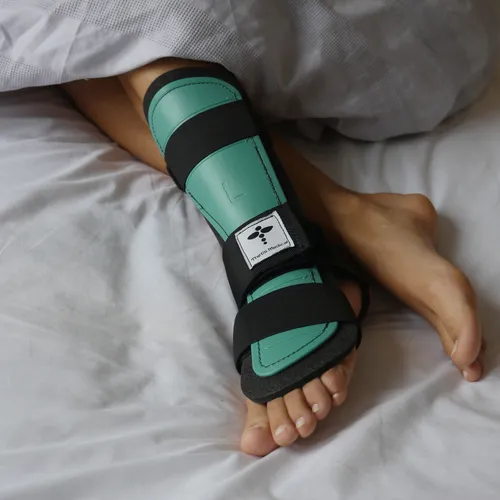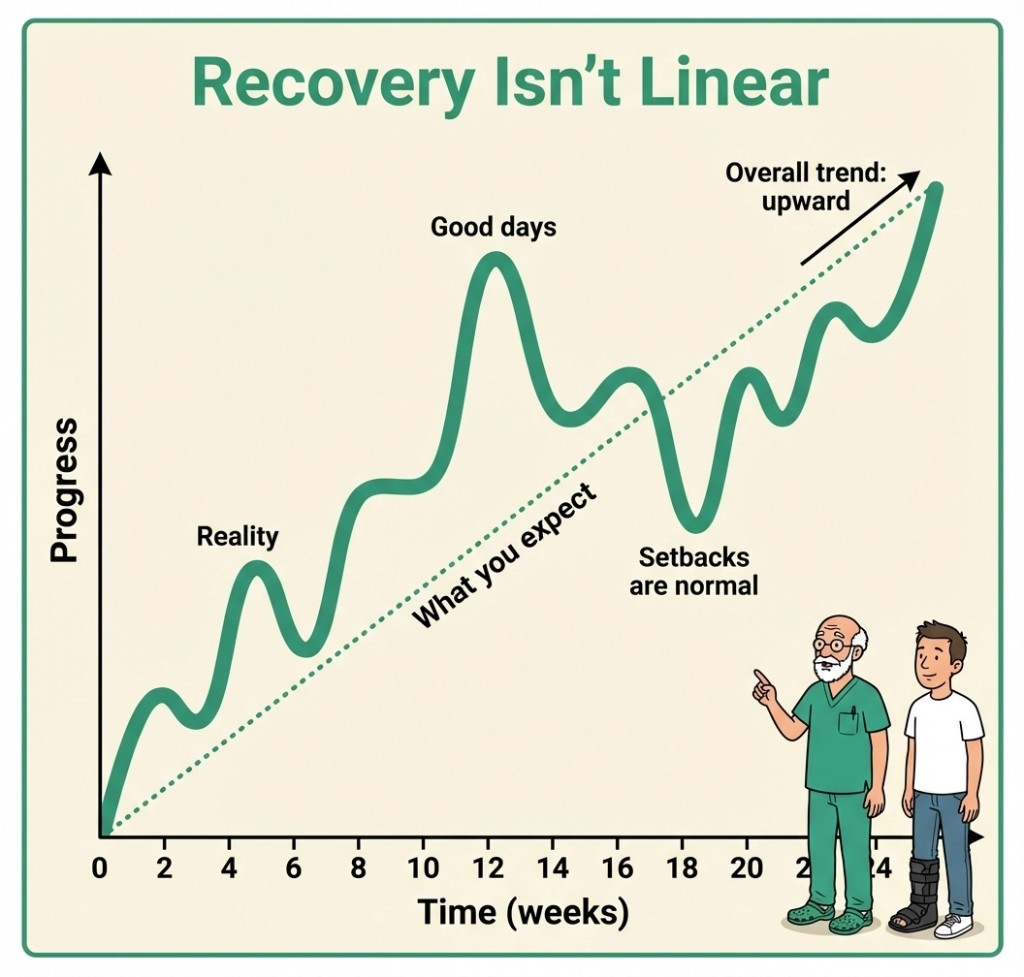
Achilles rupture recovery is rarely a straight line. Many patients expect progress to improve week after week without setbacks. In reality, most journeys include good days, frustrating days, plateaus, and occasional dips along the way.
That can feel alarming — especially when social media timelines suggest everyone is running again by month four. The important question is not whether every week is better than the last. It is whether the overall trend is moving forward.
Contents
- Key takeaways
- Why recovery is not linear
- What a normal plateau looks like
- Common reasons progress feels slow
- Setback vs real problem: how to tell
- What to do when progress stalls
- What this means for your recovery
- Frequently asked questions
- References
Key takeaways
- Achilles recovery is rarely linear — plateaus and setbacks are common.
- A brief flare after a harder day is not automatically failure if symptoms settle within 24–48 hours.
- The goal is an overall upward trend over weeks, not perfect daily improvement.
- Common slow-progress causes include inconsistent rehab, progressing too fast, calf weakness, and tendon elongation.
- Fear of re-injury can slow progress as much as physical weakness.
- Full recovery often takes 12–18 months, not a few months.
- A sudden pop, sharp pain, or loss of push-off needs urgent medical review.
Why recovery is not linear
Tendon healing is biological, not mechanical. After rupture, the Achilles goes through inflammation, repair, and remodelling — and remodelling continues for many months after the tendon has technically “healed.”
Research on persistent deficits after Achilles rupture shows that recovery often takes longer than six months, and meaningful improvement can still be happening at one year. Patient-reported scores do not always return to pre-injury levels quickly, even when day-to-day life feels much better.
Think of recovery like the game Snakes and Ladders. Each week can move you closer to the finish — but one small mistake, like removing a wedge early or sprinting before your calf is ready, can be like landing on the big snake that takes you right back to the beginning.
Good weeks and flat weeks can coexist. That is normal.
What a normal plateau looks like
A plateau does not always mean something is structurally wrong. Often it means your body is adapting to a new level of load.
| Normal plateau sign | What it usually means |
|---|---|
| Brief stiffness after a harder walk or exercise session | Tissue adapting to increased load |
| A flat week after progressing rehab | Neuromuscular system catching up |
| Good days and bad days within the same fortnight | Normal variability during remodelling |
| Symptoms settle within 24–48 hours | Load was slightly high but manageable |
| Overall month-to-month improvement | Recovery is still on track |
The sharper distinction is between a wobble and a flat line. A brief flare after a harder session is not automatically failure if the overall week-to-week picture keeps moving forward.
If you are around six months and wondering whether you are “behind,” read Achilles rupture recovery at 6 months for what is normal at that stage.
Common reasons progress feels slow
When progress stalls, there is usually a reason — and it is not always “the tendon failed.”
| Reason | What it looks like | What helps |
|---|---|---|
| Inconsistent rehabilitation | Exercises done in bursts, then skipped for days | Short, regular sessions beat occasional long ones |
| Progressing too quickly | Flare after boot changes, running, or jumping too soon | Step back one level and rebuild tolerance |
| Ongoing calf weakness | Poor heel raises, limp when tired, weak stairs | Heel raise progression |
| Tendon elongation | Flat foot feeling, weak push-off, persistent limp | Follow protocol exactly; see tendon elongation and compliance |
| Fear of re-injury | Avoiding loading, hesitant gait, anxiety about sport | Graded exposure with clear criteria and clinician support |
| Lifestyle factors | Poor sleep, smoking, high stress, irregular routine | Address basics alongside physio |
| Normal remodelling time | Strength improving slowly despite good effort | Patience — full adaptation takes months |
More than half of patients report fear of re-injuring the tendon in long-term follow-up studies. That fear is linked to lower function scores and less physical activity — not because patients are overreacting, but because confidence needs rebuilding alongside strength.
Setback vs real problem: how to tell
A temporary setback does not automatically mean something is wrong. But some patterns need review.
Usually normal (monitor and adjust load)
- Mild soreness after a harder day that settles within 24–48 hours
- A stiff morning after increasing walking distance
- One bad week followed by improvement the next
- Feeling frustrated but still meeting gradual functional goals
Speak to your physiotherapist or specialist
- Persistent weakness with no progress over several weeks
- Difficulty performing heel raises despite consistent rehab
- Ongoing limping that does not improve with rest
- Concerns about tendon function or push-off strength
- Pain or swelling that keeps escalating week to week
- A pattern that is flat or worsening rather than wobbling upward
Seek urgent review
- A sudden pop or snap in the calf
- Sudden sharp pain or loss of push-off
- Whole-leg swelling up to the knee (even if painless)
- Calf pain, breathlessness, or chest pain (possible blood clot)
What to do when progress stalls
When progress feels slow, resist the urge to chase calendar dates or force harder training. Consistency, measured loading, and patience are usually more important than arbitrary timelines.
Practical steps:
- Review your rehab consistency — are exercises happening most days, not just when you feel motivated?
- Check whether you progressed too fast — boot weaning, walking distance, running, or jumping added too soon?
- Focus on functional gaps — heel raises, balance, stairs, and gait quality via functional milestones
- Take a lighter week if symptoms flared — reduce load, keep moving, watch the 24–48 hour response
- Talk about fear if you are avoiding loading — psychological readiness improves over time with support
- Book a physio review if progress has been flat for more than two weeks
Remaining committed to your prescribed protocol during flat periods matters. A plateau is often a signal to adjust load or technique — not proof that recovery has failed.
What this means for your recovery
If progress feels slow, you are not alone. Qualitative research on Achilles rupture recovery describes fear, uncertainty, and frustration as common parts of the journey — especially when immobilisation ends and everyday loading begins again.
The principle remains unchanged: recovery is rarely linear. Consistency, patience, and appropriate progression matter more than chasing timelines.
Celebrate small wins — a better heel raise, a longer walk without limp, confident stairs — even when the overall picture still feels incomplete. Those wins add up over months.
For structured phase-by-phase guidance, see the Achilles recovery course and the Achilles rupture rehabilitation FAQ.
Frequently asked questions
Is it normal for Achilles recovery to plateau?
Yes. Recovery after Achilles rupture is rarely a straight line. Brief plateaus, stiff days, and small setbacks are common, especially when load increases. What matters is whether the overall trend is moving forward over weeks, not whether every single day is better.
Why does my Achilles recovery feel slow?
Common reasons include inconsistent rehab, progressing too quickly, ongoing calf weakness, tendon elongation affecting push-off, fear of loading the leg, and normal tissue remodelling that takes many months. Full recovery often continues for 12–18 months.
When is a setback not normal after Achilles rupture?
Speak to your clinician if you get a sudden pop, sharp new pain, loss of push-off, worsening limp that does not settle, persistent weakness with no progress over several weeks, or whole-leg swelling. A brief flare after one harder day is different from a pattern that keeps getting worse.
Should I push through a plateau in Achilles rehab?
Usually no. A plateau often means your current load needs adjusting — more consistency, a lighter week, or better exercise technique — not forcing harder training. Chasing calendar dates is a common cause of avoidable setbacks.
How long does full Achilles rupture recovery take?
Many patients improve steadily through the first year, but full strength, confidence, and sport readiness often take 12–18 months. Research shows meaningful deficits can still be present at one year, which is why criteria-based progression matters more than arbitrary dates.
References
- Maffulli N, et al. Persistent Deficits after an Achilles Tendon Rupture: A Narrative Review. Journal of Clinical Medicine. 2024.
- Jónsdóttir US, Nilsson Helander K, Larson MEH, et al. Factors That Affect Return to Sports After an Achilles Tendon Rupture: A Qualitative Content Analysis. Orthopaedic Journal of Sports Medicine. 2023.
- Psychological Factors Change During the Rehabilitation of an Achilles Tendon Rupture: A Multicenter Prospective Cohort Study. Orthopaedic Journal of Sports Medicine. 2021.
- Fear of reinjury after acute Achilles tendon rupture is related to poorer recovery and lower physical activity postinjury. Journal of Experimental Orthopaedics. 2025.
- The experience of individuals following non-surgical management of Achilles tendon rupture in the United Kingdom – a qualitative study. PLOS One. 2025.
Primary source: Maffulli N, et al.. Persistent Deficits after an Achilles Tendon Rupture: A Narrative Review