Life after Achilles rupture is one of the most important conversations in recovery — and it often happens after the major milestones are behind you. Many patients return to walking, work, exercise, and even sport. But the tendon will probably never be exactly the same as it was before injury.
That is normal. It does not mean recovery failed.
Contents
- Key takeaways
- Your tendon will not be identical — and that is okay
- Long-term changes that are usually normal
- What many patients can still achieve
- Habits that support life after injury
- Warning signs you should not ignore
- What this means for your recovery
- Frequently asked questions
- References
Key takeaways
- Life after Achilles rupture is about function, not getting an identical tendon back.
- Tendon thickening, calf asymmetry, and scar tissue are common long-term changes.
- These changes do not necessarily limit an active lifestyle.
- Long-term success depends on ongoing habits: calf strength, warm-ups, gradual progression, and listening to your body.
- Many patients return to work, exercise, and sport despite permanent adaptations.
- A sudden pop, sharp pain, or loss of push-off still needs urgent medical review.
Your tendon will not be identical — and that is okay
After rupture, the Achilles goes through repair and remodelling. The healed tendon is new tissue — not a perfect copy of the original. Research reviews show that rupture leaves long-term changes in the muscle–tendon unit, whether treatment was surgical or non-surgical.
Studies following patients for many years still find side-to-side differences in tendon size, calf bulk, and jump or heel-raise performance. That can sound discouraging, but it matches what many clinicians see in clinic: patients can function well even when scans and measurements are not perfectly symmetric.
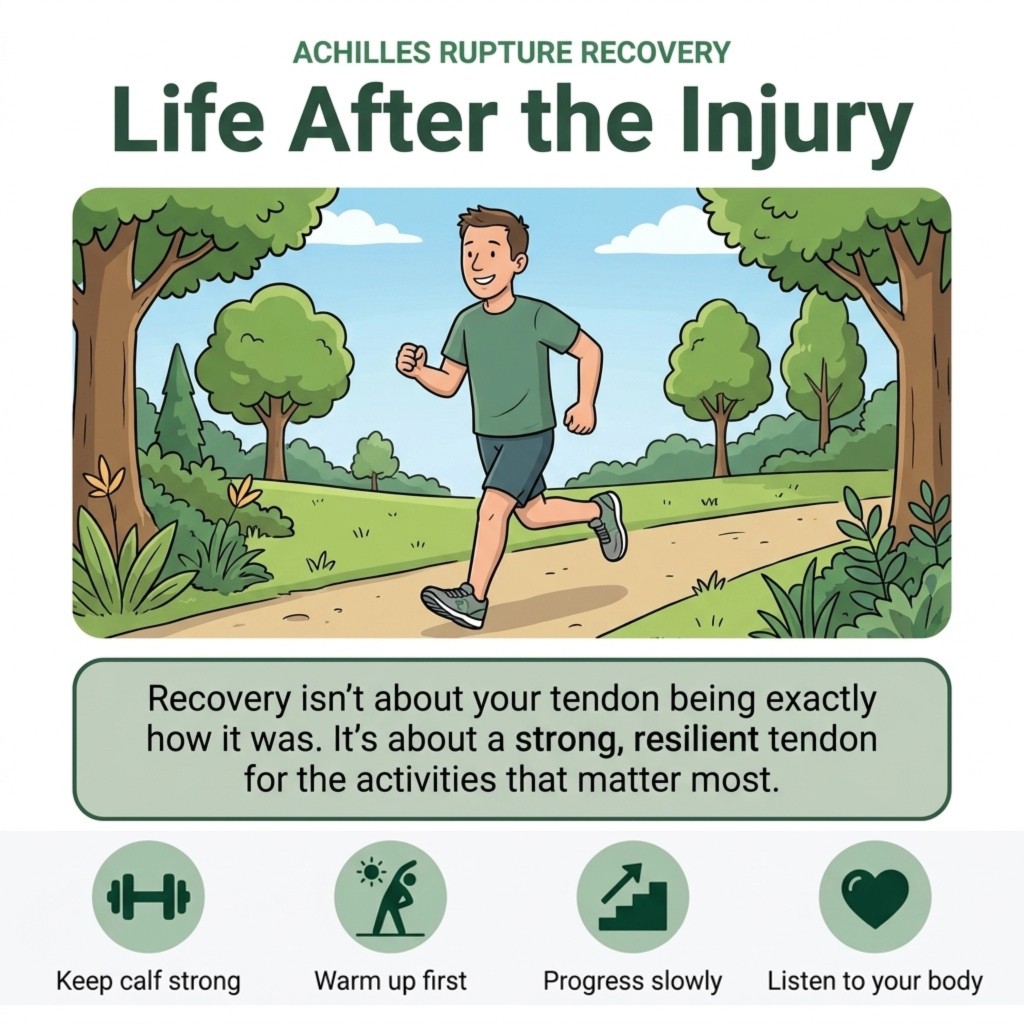
The goal of rehabilitation is not biological replication. It is functional restoration — building a strong, resilient tendon that lets you return to the activities that matter most.
Long-term changes that are usually normal
| Change | What patients notice | Is it a problem? |
|---|---|---|
| Thicker Achilles tendon | A fuller or lumpier tendon under the skin | Usually normal and often permanent; does not always affect function |
| Calf size difference | One calf looks smaller than the other | Common after boot immobilisation; functional strength matters more than perfect size |
| Scar tissue at rupture site | Firm area along the tendon | Normal part of healing |
| Tendon feels different during activity | Stiffer, tighter, or less “springy” than before | Common; many patients adapt well with ongoing strengthening |
| Slightly reduced explosive power | Less bounce on hops or sprints compared with pre-injury | Can persist on testing; daily life and moderate sport are still achievable for many |
Some tendon elongation (healing in a longer position) can also affect push-off power long term. If you are concerned about flat foot feeling or weak stairs, read long-term strength after Achilles rupture and discuss testing with your physiotherapist.
For what is normal around the six-month mark, see Achilles rupture recovery at 6 months.
What many patients can still achieve
Permanent structural changes do not automatically mean you are limited forever. Many people return to:
- Daily walking and stairs without a limp
- Work and family life including travel and childcare
- Gym training, hiking, cycling, and swimming
- Running and recreational sport
- Competitive sport — for some patients, with criteria-based clearance and ongoing maintenance
UK follow-up research one year after rupture found that many patients were satisfied with outcome, but not everyone returned to their previous sport level — and fear of re-injury was common. That is why confidence and gradual return matter alongside strength.
Recovery is not about pretending the injury never happened. It is about living well with a rebuilt tendon.
Habits that support life after injury
Long-term tissue resilience relies on habits — not one perfect month of rehab.
| Habit | What it means | Why it helps |
|---|---|---|
| Keep calf strong | Regular heel raises and progressive loading | Maintains push-off power and tendon capacity |
| Warm up first | Prepare ankles and calves before sport or hard training | Reduces sudden load on a stiff tendon |
| Progress slowly | Increase distance, speed, or intensity in steps | Avoids overloading matured scar tissue |
| Listen to your body | Respect pain, swelling, and fatigue | Early signals prevent bigger setbacks |
| Train both legs | Do not neglect the uninjured side | Balanced loading reduces compensation injuries |
Keep calf strong
The calf is the engine behind the Achilles. Ongoing strengthening — often including single-leg heel raises when cleared — helps maintain the capacity you rebuilt during rehab.
Warm up properly
A cold, stiff tendon tolerates sudden sport loads poorly. A simple warm-up before running, court sport, or gym work prepares the ankle and calf for higher demand.
Progress training gradually
Sudden spikes in volume or intensity are a common cause of late setbacks. Build gradually, especially when returning to running or plyometrics.
Listen to warning signs
Mild next-day stiffness can be normal. Sharp pain, new swelling, a worse limp, or a sudden pop is not. See preventing re-rupture after recovery for habits that reduce risk.
Warning signs you should not ignore
Life after injury still requires attention. Seek review if you notice:
- A sudden pop or snap in the calf
- Sharp new pain or sudden loss of push-off
- Worsening limp that does not settle with rest
- Progressive weakness over weeks despite consistent training
- Whole-leg swelling up to the knee (possible blood clot — seek urgent review)
A thicker tendon or smaller calf alone is not an emergency. A sudden change in function is different from a stable long-term difference.
What this means for your recovery
Perhaps the most important lesson is this: recovery is not about getting your tendon back to exactly how it was before. It is about building a strong, resilient tendon that allows you to return to the activities that matter most to you.
You may always notice differences — in appearance, feel, or explosive power. Many patients live full, active lives anyway. The patients who do best long term often keep the habits that supported recovery: consistency, patience, measured loading, and attention to warning signs.
If you are still in the middle of rehab and progress feels slow, read when recovery is not linear. For broader long-term questions, see life after Achilles rupture and the Achilles recovery course.
Frequently asked questions
Will my Achilles tendon go back to normal after rupture?
It will probably not be exactly the same as before injury. Many patients have permanent changes such as a thicker tendon, some calf asymmetry, or scar tissue. These changes are common and do not necessarily stop you returning to an active life.
Is tendon thickening normal after Achilles rupture?
Yes. A thicker Achilles tendon is very common after rupture and can be permanent. Thickening does not automatically mean a poor result if you can walk, climb stairs, and return to the activities that matter to you.
Why is one calf still smaller after Achilles rupture?
Some calf size difference between legs is normal after months in a boot and reduced loading. Functional strength — what you can actually do — matters more than perfect calf size, but ongoing strengthening helps long-term resilience.
What should I keep doing years after Achilles rupture?
Maintain calf strength, warm up before activity, progress training gradually, and listen to warning signs such as pain or excessive fatigue. Looking after both legs, not just the injured side, supports long-term function.
Can I live an active life after Achilles rupture?
Yes. Many patients return to work, exercise, and sport despite permanent structural changes. Success is usually about building a strong, resilient tendon for the activities that matter most — not getting an identical tendon back.
References
- Kozinc Ž, Šarabon N. Long-Term Deficits in Muscle Composition, Performance and Quality of Movement after Achilles Tendon Rupture: A Review. Biomed. 2023.
- Maffulli N, et al. Persistent Deficits after an Achilles Tendon Rupture: A Narrative Review. Journal of Clinical Medicine. 2024.
- Structure and Function of the Achilles Tendon and Plantarflexors 1 Year Following Achilles Tendon Rupture in the United Kingdom. Journal of Foot and Ankle Research. 2025.
- Morphological and Functional Outcomes >13 Years After Achilles Tendon Rupture. Orthopaedic Journal of Sports Medicine. 2020.
- Silbernagel KG, Steele R, Manal K. Deficits in Heel-Rise Height and Achilles Tendon Elongation Occur in Patients Recovering from an Achilles Tendon Rupture. American Journal of Sports Medicine. 2012.
Primary source: Kozinc Ž, Šarabon N. Long-Term Deficits in Muscle Composition, Performance and Quality of Movement after Achilles Tendon Rupture: A Review