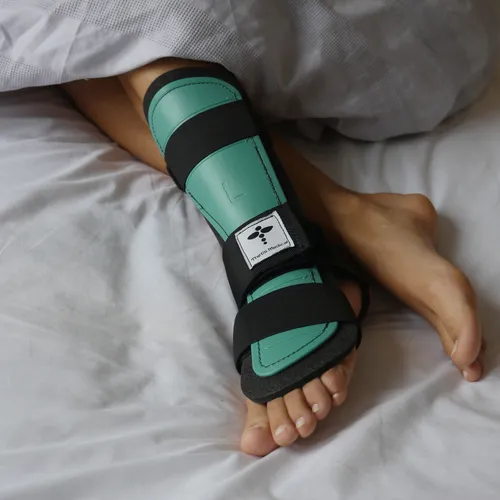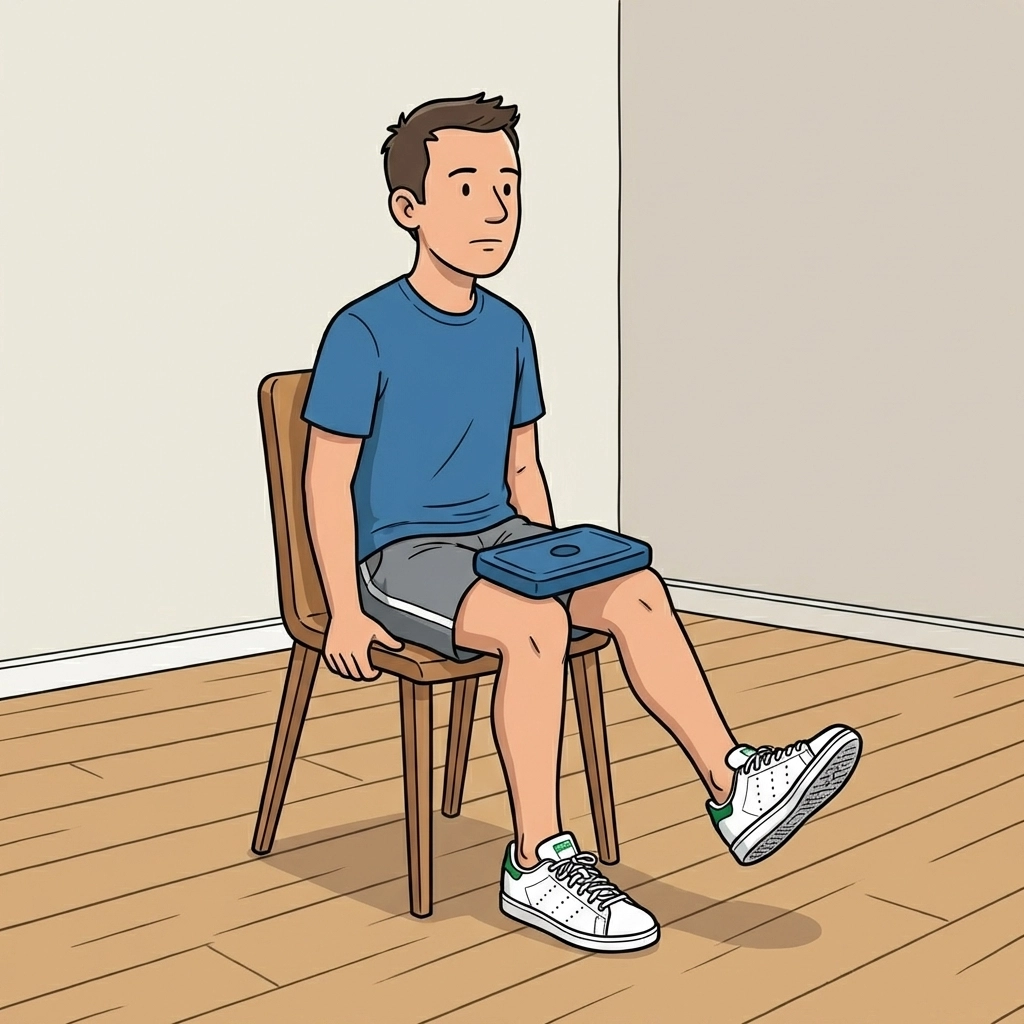
Achilles Stage 2 rehabilitation begins when protection is no longer the only goal. After boot removal, your tendon needs to relearn load, your calf needs strength back, and your nervous system needs control back. This is why Stage 2 is not “just do some exercises” - it is a planned rebuild of strength, stiffness, and coordination.
At this point, the biggest mistake is jumping straight to harder standing drills because the boot is gone. The safer pattern is: seated strength first, then progressive weight-bearing strength, then higher-demand work.
Contents
- Key takeaways
- Why Stage 2 starts with seated loading
- What a structured Stage 2 programme includes
- How to progress safely
- What this means for your recovery
- Frequently asked questions
- References
Key takeaways
- Stage 2 targets three core deficits after immobilisation: reduced plantarflexion strength, loss of tendon stiffness, and reduced balance/control.
- Seated calf raises are a strong foundation because they allow high, controllable force with lower destabilising demand.
- Progression is usually load-led, not stretch-led: add resistance first, then complexity, then speed.
- Heel-raise progression should prioritize movement quality over repetition count.
- Early aggressive stretch-heavy loading is usually avoided to reduce elongation risk.
- The practical rule is simple: strength before stretch, load before speed, control before progression.
Why Stage 2 starts with seated loading
When the boot comes off (often around the criteria-based week 10-12 window), patients lose external support but do not suddenly gain full tendon readiness. Seated calf raises solve an important transition problem:
- They let you load the calf-tendon unit in a predictable position.
- They reduce balance noise while you rebuild force tolerance.
- They prepare the tendon for gait demands before harder single-leg tasks.
That is why many protocols use seated loading early in this phase before full single-leg standing progressions. If you want specific timing context, see walking boot removal timing.
What a structured Stage 2 programme includes
A practical Stage 2 framework usually blends four streams:
| Stream | Typical purpose | Early emphasis |
|---|---|---|
| Seated calf loading | Rebuild force tolerance in a controlled setup | Slow, controlled reps with progressive external load |
| Progressive heel raises | Transition toward functional calf strength | Double-leg first, then single-leg flat-ground when criteria are met |
| Balance and control | Restore proprioception and limb coordination | Supported single-leg stance and graded challenge |
| Controlled mobility | Reintroduce movement without overload | Gentle, symptom-guided mobility, not aggressive stretching |
This structure maps to your existing library:
- Week 6 seated calf raise principles
- Balance and neuromuscular control
- Single-leg heel raise progression
- Achilles recovery course
How to progress safely
A reliable progression framework is:
- Build consistent seated loading quality.
- Add load gradually while keeping clean movement.
- Transition to standing heel-raise progression.
- Increase complexity (single-leg, unstable tasks, speed) only when control is stable.
Use these checkpoints before progressing:
| Checkpoint | Green light sign | Caution sign |
|---|---|---|
| Symptom response | Minimal next-day flare | Rising pain/stiffness/swelling over 24h |
| Movement quality | Smooth reps, no wobble collapse | Shuddering, compensations, reduced heel height |
| Gait | Improving push-off and confidence | Worsening limp or protective pattern |
| Load tolerance trend | Can do planned work repeatedly | Needs frequent de-loads to settle |
If caution signs appear, that is usually a load-management problem, not a failure. Step back one level, tighten form, and retest progression with your physio.
What this means for your recovery
Do:
- Treat seated calf loading as serious strength work, not a warm-up.
- Track next-day response so progression is data-led.
- Progress by adding load gradually before adding stretch-heavy ROM.
- Combine strength with balance and gait drills to avoid isolated “gym strength” that does not transfer.
Avoid:
- Jumping from seated work straight to high-strain variations.
- Chasing rep targets with poor movement quality.
- Assuming boot removal means tendon maturity is complete.
For broader patient guidance, the Achilles rupture rehabilitation FAQ covers stage logic in plain language.
Frequently asked questions
Why do seated calf raises come before harder standing work?
Because they let you train force in a controlled setup while the tendon is still adapting post-boot.
How should I move from seated to standing loading?
Usually through graded steps: seated -> double-leg standing -> single-leg flat-ground -> heavier and more complex work.
Are reps or quality more important?
Quality first. Reps matter, but only if movement remains controlled and symmetrical.
Should I stretch aggressively in Stage 2?
Usually no. Stage 2 is primarily a loading and control phase, not a max-stretch phase.
What signs mean I need to slow down?
Worsening next-day symptoms, poorer heel-raise quality, or gait deterioration are common cues to de-load.
References
-
Zellers JA, Carmont MR, Grävare Silbernagel K. Defining Components of Early Functional Rehabilitation for Acute Achilles Tendon Rupture: A Systematic Review. Orthop J Sports Med. 2019;7(11):2325967119884071. https://doi.org/10.1177/2325967119884071
-
Willits K, Amendola A, Bryant D, et al. Operative versus Nonoperative Treatment of Acute Achilles Tendon Ruptures: A Multicenter Randomized Trial Using Accelerated Functional Rehabilitation. J Bone Joint Surg Am. 2010;92(17):2767-2775. https://doi.org/10.2106/JBJS.I.01401
-
Silbernagel KG, Steele R, Manal K. Deficits in Heel-Rise Height and Achilles Tendon Elongation Occur in Patients Recovering from an Achilles Tendon Rupture. Am J Sports Med. 2012;40(7):1568-1575. https://doi.org/10.1177/0363546512447926
-
Hullfish TJ, Woods MM, Kwon MP, Boakye LA, Humbyrd CJ, Baxter JR. The Difference in Achilles Tendon Loading within Immobilizing Boots Based on Ankle Angle, Boot Type, and Walking Speed. Orthop J Sports Med. 2024;12(10):23259671241283806. https://doi.org/10.1177/23259671241283806
Primary source: Zellers JA, Carmont MR, Grävare Silbernagel K. Defining Components of Early Functional Rehabilitation for Acute Achilles Tendon Rupture: A Systematic Review