Returning to work after Achilles rupture is part of rehabilitation. By around week 20-22, many patients are no longer focused only on the tendon. They are trying to return to work, commuting, household jobs, social life, and normal routines.
That stage is often underestimated. Walking may be improving, but recovery is still ongoing. A full working day can be a bigger rehab load than a formal physio session.
Contents
- Key takeaways
- Why normal life is still rehabilitation
- Desk work versus physical work
- Practical return-to-work adjustments
- Commuting and daily routines
- Fatigue after Achilles rupture
- Household tasks and social life
- What this means for your recovery
- Frequently asked questions
- References
Key takeaways
- Returning to work after Achilles rupture depends on job demands, not just the week number.
- Desk-based work may be possible earlier with adjustments; physical work usually needs a slower, modified return.
- Prolonged standing, commuting, heavy lifting, ladders, and rushing between tasks can all overload recovery.
- Fatigue is common. Healing, walking differently, strength rebuilding, and mental vigilance all cost energy.
- A gradual return is usually more successful than going from rest to full capacity overnight.
- More swelling, pain, stiffness, or limp after work means the total load needs adjusting.
Why normal life is still rehabilitation
Formal rehab exercises are only one part of recovery. Normal life adds a large background load:
- Walking to and from transport
- Standing in queues
- Carrying a laptop bag or shopping
- Sitting with the ankle hanging down
- Stairs at home or work
- Longer days with fewer chances to rest
Each item may look small, but together they can be enough to irritate the recovering tendon-calf unit. This is why many patients feel fine during a short walk but struggle after a full day at work.
Patient rehabilitation guidance often reminds people that the tendon takes months to regain strength and flexibility, and that activities of daily living still need care while the tendon remains vulnerable. That is exactly the point here: normal life is not separate from rehab; it is one of the biggest parts of rehab.
If you are trying to understand where work fits in the bigger picture, the Achilles rupture rehabilitation FAQ is a useful starting point.
Desk work versus physical work
Return-to-work timing varies because jobs vary.
| Work type | What usually helps | What can make it harder |
|---|---|---|
| Desk-based work | Sitting options, leg elevation, flexible hours, working from home | Long commute, ankle swelling from sitting, lack of breaks |
| Mixed duties | Modified tasks, phased hours, avoiding long standing | Walking between sites, carrying equipment, unpredictable demands |
| Physical work | Occupational health plan, lighter duties, gradual exposure | Heavy lifting, ladders, kneeling, uneven ground, time pressure |
| Driving-based work | Clear driving clearance, safe braking, planned breaks | Manual vehicles, right-foot injury, long pedal time, fatigue |
Some NHS patient leaflets suggest office-based work may be possible earlier, while more physical work may take longer, often with modified duties. These are broad examples, not promises. Your own plan should reflect treatment type, wound healing, boot status, walking quality, swelling, job demands, and clinician advice.
If driving is part of work, read when can I drive after Achilles rupture? before making assumptions.
Practical return-to-work adjustments
Small adjustments can prevent a normal workday from becoming an accidental overload test.
Useful strategies include:
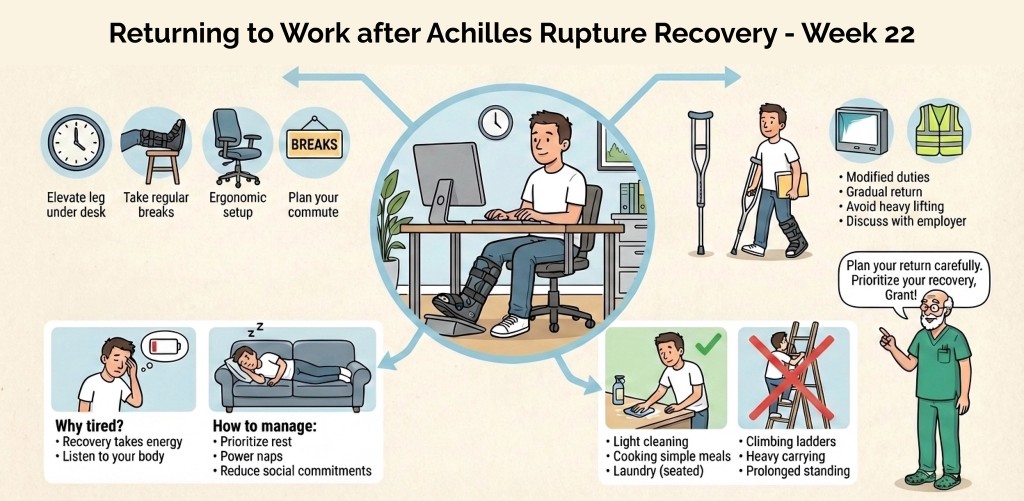
- Elevate the leg when possible, especially if swelling builds through the day.
- Take regular movement breaks rather than sitting still for hours.
- Use an ergonomic setup so the ankle is not dangling unsupported all day.
- Plan the commute so you are not rushing, standing for long periods, or carrying heavy bags.
- Start with shorter days or flexible hours if your employer can support it.
- Use modified duties for physical jobs.
- Avoid heavy lifting, ladders, prolonged standing, and uneven ground early on.
For a physical role, be specific with your employer. “Light duties” can mean very different things to different people. It is better to define the actual restrictions: no ladders, no heavy carrying, limited standing time, no uneven ground, no emergency manual handling, or whatever your clinician recommends.
Commuting and daily routines
The workday often starts before work. The commute can be the hardest part.
Think about:
- Distance from parking or public transport to the workplace
- Stairs, escalators, and wet surfaces
- Whether you can sit during the journey
- Whether you need to carry a laptop, bag, or tools
- Whether rush-hour crowds increase fall risk
- Whether you can leave earlier to avoid rushing
If the commute is too much, home working or hybrid work may be a more important adjustment than the desk setup itself.
Daily routines matter too. A full day might include work, food shopping, school pickup, cleaning, cooking, and social plans. That can be far more than the tendon has been asked to tolerate so far. Plan the whole day, not just the office hours.
Fatigue after Achilles rupture
Fatigue is not laziness. Many patients describe lower energy, heavier legs, and mental tiredness during the return to normal life.
That makes sense. Your body is healing tissue, rebuilding muscle, relearning gait, and managing swelling. You may also be concentrating more than usual on every step, kerb, stair, wet floor, and crowded corridor.
The Achilles Tendon Total Rupture Score, a patient questionnaire used in Achilles research and follow-up, even asks about limitation because of fatigue in the calf, Achilles tendon, or foot. In other words, fatigue is a recognised part of the recovery experience, not something patients have invented.
Practical pacing can include:
- Prioritising the most important work tasks early in the day
- Taking short rest breaks before symptoms spike
- Reducing social commitments during the first weeks back
- Using brief naps or quiet rest if fatigue is high
- Avoiding a “catch up on everything” weekend after a full work week
The aim is not complete avoidance. The aim is a load your tendon and nervous system can recover from by the next day.
Household tasks and social life
Household jobs count as load. So does social life.
| Usually lower demand | Often higher demand |
|---|---|
| Light cooking with breaks | Cooking while standing for a long time |
| Simple cleaning in short blocks | Deep cleaning or moving furniture |
| Laundry while seated or with help carrying | Carrying heavy baskets on stairs |
| Short social visit with seating | Long events with standing, crowds, or alcohol |
| Planned supermarket trip with support | Rushed shopping while carrying heavy bags |
Alcohol, crowds, poor lighting, and slippery floors can all increase fall risk. If you are still rebuilding balance and confidence, choose the boring safe option for a while. That is not weakness; it is good tendon management.
If balance and stairs are your main problem, the articles on functional milestones after Achilles rupture and balance after Achilles rupture explain what to work on.
What this means for your recovery
Returning to normal life should be planned like rehab progression. Increase one thing at a time: hours, commute distance, standing time, household load, or social activity. Do not increase all of them in the same week.
Use the next morning as your guide. If pain, swelling, stiffness, limp, or fatigue jumps after a workday, the total load was too high. That does not mean you have failed. It means the plan needs adjusting.
Seek urgent medical review if you feel a sudden pop, sharp pain, loss of push-off, a new gap in the tendon area, or a sudden major change in walking. If swelling climbs up the whole leg, especially with calf pain, breathlessness, or chest pain, seek urgent review for a possible blood clot.
For structured education through this phase, see the Achilles recovery course.
Frequently asked questions
When can I return to work after Achilles rupture?
Return to work depends on your job. Office-based work may be possible earlier with adjustments, while physical jobs often need a slower, modified return. Your clinician, employer, and occupational health team should guide the plan.
Why am I so tired after going back to work after Achilles rupture?
Fatigue is common because walking, commuting, concentrating, and protecting the leg all cost more energy during recovery. It does not mean you are failing, but it is a sign to pace your week carefully.
What work adjustments help after Achilles rupture?
Useful adjustments include leg elevation, regular movement breaks, reduced prolonged standing, flexible hours, home working, modified duties, safe commuting plans, and avoiding heavy lifting or ladders early on.
Can I do household tasks after Achilles rupture?
Yes, but treat household tasks like rehab load. Light cooking, simple cleaning, and seated laundry may be reasonable, while heavy carrying, ladders, long standing, and rushed stairs should wait until strength and balance improve.
What signs mean I am doing too much at work?
More swelling, rising pain, worse morning stiffness, increased limp, unusual fatigue, or reduced heel-raise quality after work usually mean the overall load is too high and should be adjusted.
References
- Royal Berkshire NHS Foundation Trust. Achilles Tendon Rupture: Management and Rehabilitation.
- Cambridge University Hospitals NHS Foundation Trust. Achilles tendon rupture: management and rehabilitation.
- Zellers JA, Carmont MR, Grävare Silbernagel K. Defining Components of Early Functional Rehabilitation for Acute Achilles Tendon Rupture: A Systematic Review. Orthopaedic Journal of Sports Medicine. 2019.
Primary source: Royal Berkshire NHS Foundation Trust. Achilles tendon rupture: management and rehabilitation