If you rupture your Achilles, you will almost certainly spend weeks in an Achilles walking boot—often with foam heel wedges, sometimes with hinged rocker boots guided by posterior struts. Social threads love the phrase “hinge versus wedge”, but the humbler subject of wedge geometry—how those wedges support your heel, compress over time, and spread load through the sole—also changes what your tendon experiences when you bear weight.
This article translates what that means for you as a patient, centred on rigorous lab papers from Hullfish’s group (2024 summary paper; 2020 methods foundation) plus older work asking whether popular orthoses really hit planned early equinus angles (Ellison and colleagues, imaging-driven study). Practical boot choices still line up with our plain-language comparison Aircast vs VACOped and your prescribed wedge removal schedule—this science adds nuance, not permission to freestyle.
Ground rule: Hullfish 2024 used young healthy walkers estimating tendon load from validated instrumented insoles. That is hugely useful science, but it is not the same as duplicating numbers inside every NHS plaster room—the figures inform conversations, they do not replace your clinician.
Contents
- Key takeaways
- Angles on paper versus boots under body weight
- What Hullfish et al. (2024) actually tested
- Older context: wedges, shells, rocker geometry
- Wearable monitors (where research is headed)
- Wedge upkeep and adherence
- What this means for your recovery
- Frequently asked questions
- References
Key takeaways
- Foam wedge stacks translate “30° → 15° → 0°” drawings into mechanical reality—but effective angle equals plastic + foam deformation + how your heel sits, not only the schematic.
- Hullfish 2024 found estimated Achilles tendon load depended most on ankle angle setting, secondly on boot construction (softshell wedge vs hardshell wedge vs hardshell posterior strut boot archetypes studied), thirdly on walking speed.
- Loads diverged more in deeper plantarflexion, while authors reported narrower gaps between boots nearer neutral ankle positions, underscoring that late-boot discipline still matters.
- Comfort, skin integrity, and actually wearing the device beat owning the “perfect” catalogue model—consistent use beats premium hardware sitting in a cupboard (themes we repeat on Achilles rupture rehabilitation FAQs).
- Never change wedges, liners, or boot models solo because a chart looked prettier—supply, insurance coverage, orthotic availability, and medico‑legal prescribing all sit with your fracture team.
Angles on paper versus boots under body weight
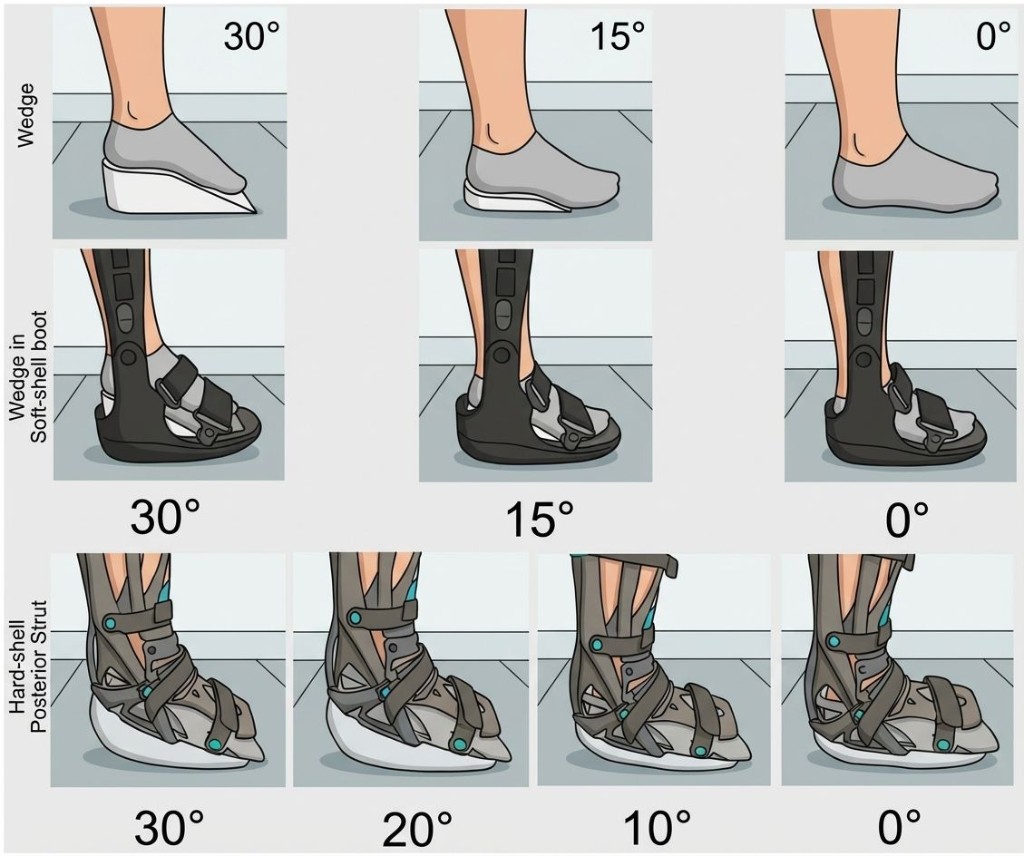
Teaching graphics (like ours) neatly line up bare wedges, wedges inside a soft boot, and rocker strut boots because it helps you visualise plantarflexion (toes-down) targets. In clinic, three practical layers sit on top of the drawing:
| Layer | Plain-language point |
|---|---|
| Heel capture | If the heel floats or slides, the ankle can sneak toward dorsiflexion at the wrong time. |
| Load distribution | Hard shells, foam beds, and rocker soles route pressure differently through hindfoot versus forefoot. |
| Material behaviour | Foam compresses; liners pack down; you may need refreshers from orthotics. |
| Weight-bearing vs non-weight-bearing | The foot can look sharply pointed when unloaded, then subtly settle when you load it. |
| Walking speed | Every lab study agrees: hurry taxes the tendon sooner than a slow, short stride. |
What Hullfish et al. (2024) actually tested
Ten healthy adults walked in running shoes and three immobilising boots while researchers streamed instrumented insole data (Loadsol II) to estimate peak Achilles tendon load across combinations of angle and self-selected walking speed (slow, medium, fast).
The paper labels the boots by construction + immobilisation style (not as brand shopping advice):
| Study label | What it maps to in the paper | Immobilisation style |
|---|---|---|
| Softshell wedge boot | United Ortho Air Cam Walker | Stacked foam wedges |
| Hardshell wedge boot | Aircast Air Select walker | Stacked foam wedges inside a firmer shell |
| Hardshell posterior-strut boot | VACOped | Posterior strut / rocker mechanism with discrete angle stops |
Angle settings: wedge boots were tested at 30°, 15°, 0° using 64 mm and 23.5 mm stacks (and no wedge at 0°). The posterior-strut boot used 30°, 20°, 10°, 0°; for fair comparison the team averaged the 20° and 10° data to mirror a 15°-style checkpoint.
Headline results (from the paper’s abstract and discussion):
- Every boot reduced estimated tendon load compared with normal shoes.
- Changing immobilisation angle moved loads the most—supporting why early equinus protection is non‑negotiable in protocols.
- Boot construction still mattered statistically—this is the patient-friendly version of the social post’s wedge-geometry emphasis: nominal degrees matched on paper do not guarantee identical tendon load in vivo.
- Walking speed mattered after those two—another lever clinicians can coach (slow, short steps early; no “sneaky sprint” to the car).
- When ankles were near neutral (0°), boot-to-boot differences tightened—progression quality still counts late, not only in week one.
The team built on their earlier instrumented boot validation (Hullfish et al., 2020 J Biomech), which is why these comparisons are taken seriously in biomechanics circles.
Older context: wedges, shells, rocker geometry
Before modern loading studies, Ellison and colleagues used imaging-driven biomechanics to ask whether common walking boots + wedge stacks deliver the plantarflexion angles surgeons expect during early protected weight-bearing—worth citing because it already hinted that “labelled angle” and achieved angle are not always identical across devices and liners.
That does not mean consumer boot-hopping fixes everything; it means professional fitting + follow-up matter.
Wearable monitors (where research is headed)
A 2023 Scientific Reports paper from overlapping authors (Kwon et al.) piloted IMU sensors + machine learning to estimate tendon load and walking speed inside a boot across wedge settings. Translation: clinics may eventually track real-world cadence and load progressions more easily than today’s occasional gait-lab visits.
For now, assume your rehab still rides on clinical examination, symptom rules, and protocol milestones—not a consumer gadget.
Wedge upkeep and adherence
- Photograph your wedge stack at fitting—future-you can compare height if something feels “off.”
- Check skin daily; hotspot pressure is a medical issue, not a willpower issue.
- Level the other leg (commonly with an EVENup-style shoe leveler) so hip and back pain do not make you limp and cheat loading.
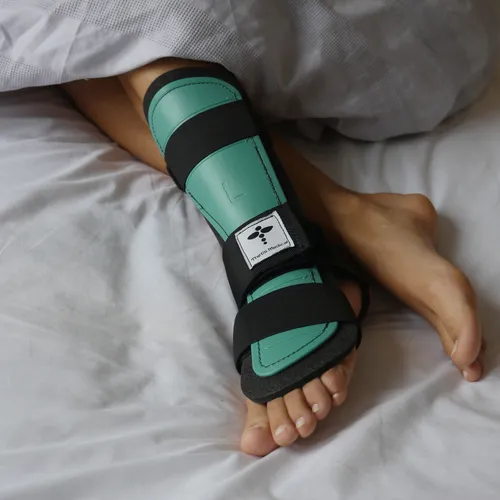
- If sleeping in the boot is destroying compliance, ask your team about night-splint options that still protect the tendon—different hospitals set different rules.
What this means for your recovery
Do
- Follow wedge removal exactly as prescribed in your pathway.
- Keep walks slow and short unless your team widens the goalposts—speed is a hidden load dial.
- Bring questions to clinic using articles like this as conversation starters, not arguments.
Avoid
- DIY insole stacking that secretly changes ankle angle.
- Buying random third-party wedges online with unknown thickness.
- Letting social-media boot wars erode trust in a working prescription you are tolerating.
If you want structured education alongside boot weeks, the Achilles rupture recovery course walks timeline concepts in plain English—complementary to your hospital leaflet, not a substitute.
If you notice a new pop, marked calf gap, numbness, or rapidly worsening pain after a stumble, treat that as urgent—boot engineering cannot fix a fresh medical problem.
Frequently asked questions
If two boots aim for the same toe-down angle, why would tendon loading differ?
Because shell stiffness, liner thickness, wedge material, heel counter shape, and rocker geometry all change how ground reaction forces become ankle moments and therefore Achilles estimates—even when diagrams look identical.
Does this mean one boot brand automatically wins?
No. Lab differences are real, but rupture trials and clinical experience still emphasise protocol quality and patient adherence. Most people succeed with whatever boot their hospital issues, provided wedges and physio milestones are respected.
Could my foam wedges compress?
Yes—foam can bed in and liners can pack down. If your alignment feels less protective, get professional review rather than improvising.
Why does walking speed matter?
Faster walking raises estimated tendon load inside the same boot setting. It is why “I only walked to the shop” can still overload a tendon if the shop visit was a rush.
Should I switch boots because of a graph I saw online?
Only if your fracture clinic agrees and can refit you safely—unsupervised swaps are a common way to mis-set immobilisation angles.
References
-
Hullfish TJ, Woods MM, Kwon MP, Boakye LA, Humbyrd CJ, Baxter JR. The Difference in Achilles Tendon Loading within Immobilizing Boots Based on Ankle Angle, Boot Type, and Walking Speed. Orthop J Sports Med. 2024;12(10):23259671241283806. https://doi.org/10.1177/23259671241283806.
-
Hullfish TJ, O’Connor KM, Baxter JR. Instrumented immobilizing boot paradigm quantifies reduced Achilles tendon loading during gait. J Biomech. 2020;109:109925. https://doi.org/10.1016/j.jbiomech.2020.109925
-
Ellison P, Molloy AP, Mason LW, et al. Early Protected Weightbearing for Acute Ruptures of the Achilles Tendon: Do Commonly Used Orthoses Produce the Required Equinus? Foot Ankle Surg. 2018;24(6):547-554. https://doi.org/10.1053/j.jfas.2017.06.017
-
Kwon MP, Hullfish TJ, Humbyrd CJ, Boakye LAT, Baxter JR. Wearable sensor and machine learning estimate tendon load and walking speed during immobilizing boot ambulation. Sci Rep. 2023;13:18086. https://doi.org/10.1038/s41598-023-45375-x
Primary source: Hullfish TJ, Woods MM, Kwon MP, Boakye LA, Humbyrd CJ, Baxter JR. The Difference in Achilles Tendon Loading within Immobilizing Boots Based on Ankle Angle, Boot Type, and Walking Speed